
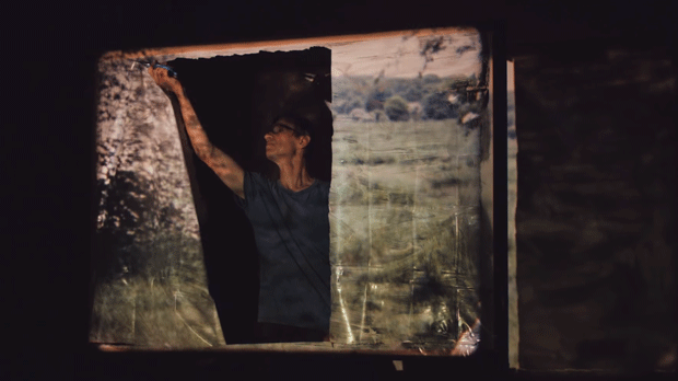

Paper Landscape transcends the dualistic boundary which most self-referential films have: cinema diegesis and the audience diegesis (“the real world”). Instead, Guy Sherwin’s film creates a funnel of time and shifting space perspectives which intervene and alter each other in a tangling flux of images. Thus, multiple diegeses interact and refer both to themselves and one another. While typical cinema has a minimum of the two diegeses by definition, in Paper Landscape (likewise, in Man with Mirror) the live performance adds another layer of complexity, which in turn gives heightend meaning to the other layers. This interplay between diegeses and their multiplicities creates the elaborate technical and thematic structure of the piece.
Mirroring Images
While Guy Sherwin Present is painting the path of film for Guy Sherwin Past, the latter is gradually revealing himself while removing a paper barrier. In contrast, Guy Sherwin Present is gradually hiding himself behind the paint. Thus, the initial opposition is twofold: adding and removing (barriers and frames), appearing and disappearing (the artist’s past and present). This is the first rendering of a series of mirroring symmetries which create the thematic structure of Paper Landscape.

The History of Art
The first documented evidence of Homo Sapiens’ symbolic thought are the cave paintings: a unique cultural landmark in the process of representation of one thing with another, thus creating symbols which move away from the physical world towards abstraction eventually culminating in language and complex society structures. Unique about the crude cave illustrations is their stasis in time, yet pretending to be a moving reality. It is the first expression of art: the violence over images, their imprisonment in time, and the power to create a more complex realm. The climax of this initial spark is the moving cinematic image.
Paper Landscape can be seen as a condensed metaphor of the progression from still to moving images. Starting with a blank paper screen, it requires a static 2-dimensional paint in order to eventually enkindle the light of the moving image. Just like 2001 condenses millions of years in a single bone cut, Paper Landscape uses the complex interaction between diegeses within the dimension of time in order to observe the progression from a static image to a cinematic sequence. 2001 presents the history of time in the grander scale, while Paper Landscape oscillates between the cultural timeline of art and the more personal narrative of an artist in-between his work.
If seen as a symbolic parallel for the history of art, Paper Landscape could also allude to the metaphor of the “autobiography of the artist”: the idea of his or her inevitable presence (ideaologicial or physical) in the artwork. Yet, despite using himself as the main element of the artwork, Guy Sherwin manages to symbolize and express the universal themes of temporality, representation, art and reality.
Past & Presence as Self-Referential
Film image is by definition in the past: a narrative already captured and documented as “has-been.” Photography, still or moving, is in essence the temporal death of its images: irrevocable and perpetual at the same time. This feature of the film medium is one of the main differences to theater which is in present tense and unrepeatable.
Paper Landscape exposes this fundamental opposition between cinema and performance and utilizes it in order to express its main ideas. The interaction between the past and the present is complex and many-fold. While the performer is creating the world of the film actor, the latter mirrors his self-creation. The interaction between the mediums conveys the duality between past and present: enhanced by the visible age difference between Guy Sherwin Actor and Guy Sherwin Performer. The perception of the present does not exist beyond projections of the past.
The Illusion of art and reality
Although the main theme of the piece is the relativity and ambiguity of both life and reality, the film adheres to strict technical execution through complex symmetry and choreography between cinema and theater. The paint brush is a contextual opposition of the torn paper screen in the same way the performer is in contrast with the actor. When Guy Sherwin Present disappears, he makes room for Guy Sherwin Past, and Guy Sherwin Past mirrors the action in a process of self-creation. The symmetry reaches its climax with the double crossing over of art borders: the film border and the performance border.

Being a narrative (film) within a narrative (live performance), the meta-narrative of Paper Landscape is self-referential through the crossing of mediums. Michael Haneke’s Funny Games breaks the fourth wall in a very direct, abrupt, and self-conscious way, obviously acknowledging the presence of the audience and addressing it directly through dialogue and plot. Guy Sherwin’s film breaks the fourth wall in a lot more physical way, but the self-reference still feels subtler and more fluid: because of the constant interaction between the “sides of the wall,” the film creates the perception of a barrier that resembles a door more than a wall.
Performance and film reference each other in a complex interplay, but remain aloof from the audience in their self-contained art world. Funny Games includes the audience as both a character and a theme of the movie, while Paper Landscape ignores the audience and puts the emphasis of the artwork on the Artist. At the end, Guy Sherwin Actor appears to be walking away from the audience: having crossed one border and gotten closer to the realm beyond the film, he decides to turn around and walk away, eventually muddling with the colors of the frame.

This sequence can be seen as a celebration of art, somewhat symbolic of the idea of “art for its own sake.” By choosing to stay within the film diegesis, the actor metaphorically “proclaims” the independence of Cinema from the audience and real life.
The dualistic nature of reality
One of the major shifts in 20th century’s culture was the increasing emphasis of linguistics and the role of language in the perception of reality, starting with Saussure’s structural linguistics and the idea that language and words have no fixed meaning outside of context. The meaning of a linguistic concept depends on its differentiation from other concepts through negation. The sum of its negative concepts defines the outer edges of a given word. A “cat” is not a “cat,” without a “dog,” or an”elephant” to be distinguished from.
Paper Landscape could be seen as an illustration of the concept of binary oppositions. Present and past, performance and film mirror each other to create the dualistic nature of the work. Blurring the boundaries between the two creates a visual and conceptual symmetry where an artist’s work is in direct interaction with the outside. The multiplicity of images creates the depth of perception and interpretation. The multi-layered complexity of diegeses defies the ability to discern the boundaries between oppositions: thus performance becomes painting, painting becomes film. The only constant in this changing symmetry is the artist: the visual conman taking on distorted appearances and physically crossing mental borders. He is the omnipotent being who travels trough time, and creates and destroys complex visual worlds only for the sake of its own performance.
