
 Nebraska by Alexander Payne focuses on the everyday, non-spectacular life of aging Woody Grant (played by Bruce Dern), his wife, and sons. With its emphasis on the non-dramatic, the film reminds of Richard Linklater’s Boyhood. Because it is defying the mainstream cinema expectations for drama and spectacle, Nebraska is probably unlikely to win the Best Picture Oscar. But the film’s subtle cinematography and directing, also nominated for Oscars, enhance the movie’s themes of triteness and realism.
The movie is black-and-white because such are the lives of its small-town characters. Their excitement consists mainly of watching TV; their conversations revolve around watering the plants and the trite what’s up—nothing, how about you—not much. Therefore, when Woody, whose judgment is distorted by age and alcohol, finds a scam flyer in his mailbox promising to win him one million dollars, his naivety and desire for a more exciting life make him believe he has already won.
Nebraska’s Cinematography

Greek Phedon Papamichael, the cinematographer for Nebraska, had known Alexander Payne for more than 20 years before Payne first approached him for Sideways. Papamichael, himself a director of 5 movies, among them From Within and Lost Vegas, said his film style is somewhat different from Payne’s, but the two have managed to find common ground in their collaborations. Papamichael is influenced by Japanese directors Ozu and Kurosawa and said his goal has always been not to call too much attention to the presence of the camera in the movie, which is probably the reason for Nebraska’s subtle cinematography.
The camera in Nebraska is mainly static, which enhances the action-less mood of the film. Occasionally, however, a slow pan establishes the scene before switching to a close-up of the characters. The setting in these pans is intentionally bare, dull, and empty, adding to the unexciting lives of the characters.

In the scene at Woody’s old house, a slow pan starts from right to left with an old abandoned barn, before gradually revealing Woody and his son David (played by Will Forte) in a long shot. Woody and David are far away and appear dwarfed by the blankness of the scenery.

The two characters are not aligned: Woody is standing out in front of David. The composition of the scene suggests a disconnection between the two—something that David is trying to correct by going on the trip with his father. Throughout their trip he finds out details about his father’s life he never suspected, which maybe suggests the two had not been very close.

In another establishing shot, a pan from left to right scans an empty cemetery and barren landscape, before introducing Woody, his wife Kate (played by June Squibb), and David. The mise en scene here is disconnected as well.

Woody appears behind Kate and David, and the three characters seem to constantly form a triangle, in which Woody appears as the odd part. He is somehow detached and removed from Kate and David, or is the one separating them.

The theme is repeated throughout the movie with variations in the composition, but is probably most prominent in the cemetery scene.

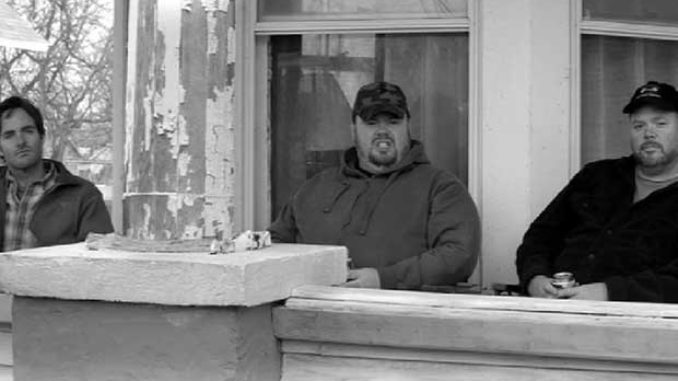
In a similar way, when David is talking to his relatives, whom he had not seen since a little kid, he cannot find common ground with them. His inability to connect with them is expressed by his visual separation in the porch scene.

Payne said in an interview (video below) he had always wanted to make a film in black and white. He said he had to convince Paramount studio and as a result received a lower budget. The director said Jim Jermusch’s early films were a visual influence on Nebraska.
Jarmusch’s movie Stranger Than Paradise was shot in black and white too, and has a somewhat similar visual composition to Nebraska.

Nebraska is nominated for 6 Oscars: Best Picture, Best Actor (Bruce Dern), Best Director, Best Supporting Actress (Jane Squibb), Best Cinematography, and Best Original Screenplay (Bob Nelson).